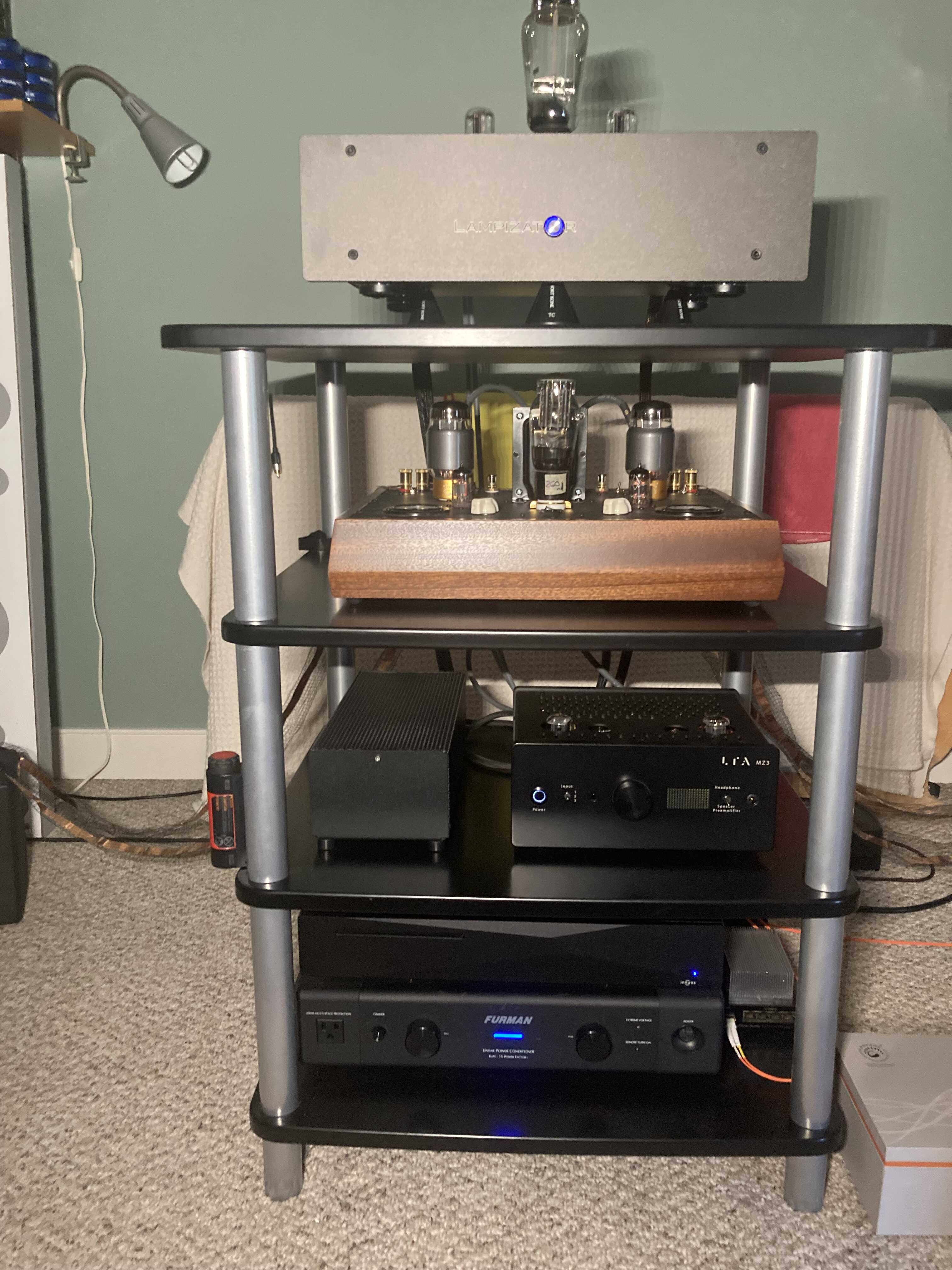
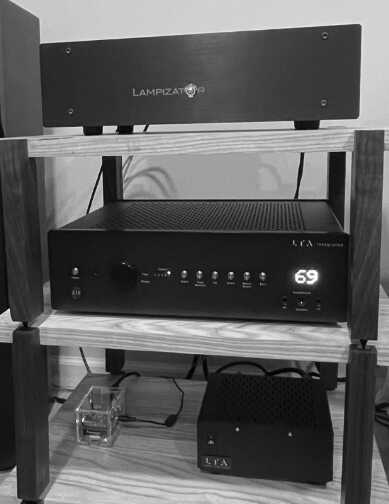
Lampizator dac thread, Amber / Baltic / Atlantic / Golden / Pacific / Horizon

Now you have me imagining those sweet stringed instruments. On good gear you can hear the tension in the instruments and the bows, I can only imagine what else is revealed on the level youre at.

Please keep us filled in as this breaks in more.

Btw, i forget often, but what is your source?

1 Like

I’m using the optical rendu on the Pacific via USB, I preferred it over the NS1 via AES.

4 Likes

I recall seeing pics of the Lampi where they change the PLL clock on their USB card. A highly modified Amanero, what’s in the Pacific?

2 Likes

Haven’t looked at the JLSounds board that is in the update, it identifies as “JLsounds Lampizator at usb-ci_hdrc.1-1.1, high speed : USB Audio”, so it at least has custom firmware.
JLSounds board is generally considered to sound better than the Amanero, they have different isolation strategies, I have no idea without looking if it’s modified like the Amanero.

I did look at the Amanero board when I was considering that upgrade in isolation, it was as you say not stock, it had two very expensive crystals hung off the board, connected with what look like silver fly wires, and additional fly wires running on to the network card. I was expecting to see a board with plugs that could be easily removed, and that was not the case, everything was hand soldered point to point.

Though if I were a betting man, I’d guess most of the change to JLSounds was because it just works on Linux/Mac and Windows, and the Amanero required re-flashing to work on Linux. If you ever had a USB issue with an older Lampizator, they would immediately email you instructions to flash it.

3 Likes

@M0N, would the Baltic 4 have good synergy with the MZ3?

Very lol, honestly any of the lampizator I’ve tried have had great synergy with the mz3, really the prime synergy I’ve tried for the lta stuff has been lampi or mojo. You might want to swap in a bit warmer leaning tubes for the baltic though depending on headphone

6 Likes

Awesome!

I’ve been eyeing DACs, and this definitely seems like a good one for my preferences/needs. The Enleum interests me as a second amp for harder to drive planars (IMO, MZ3 just doesn’t push them well). The fact that it also pairs well is nice.

I saw a guy compare his Horizon to the Baltic 4, and it was very positive. It seemed to be very similar, albeit not at the Horizon’s level of course. But he was very impressed by it.

Thanks again!

6 Likes

Yeah the mz3 falls a bit flat in that regard lol

From my experience with the Baltic 3, it very much takes after the horizon. Much much much scaled down technicality wise, but pretty similar sonic goals and signature, although I’d actually say it’s more forward than the horizon, but will depend on tubes of course. The Baltic is definitely a different direction than the amber, atlantic, and golden gate, and house sound wise is more in line with the pacific but moreso the horizon (although with the engine updates that are coming to the others they’re also getting more in line with the modern lampi sound)

7 Likes

Do you see this sweet sweet combo? It’s so damned good sounding. Stop asking and buy it already :rofl::stuck_out_tongue_closed_eyes::rofl: Mr @ValentineLuke !

14 Likes

Man. That’s a gorgeous setup.

:eyes:

2 Likes

@NickMimi you never gave your impressions on the Nordost cones, was there anything that you could hear with them?

Do it! I’ve been enjoying my Lampi/LTA setup. :+1:

13 Likes

……………:eyes:

1 Like

I am using the Nordost TC Kones w/ my Baltic 3 DAC, and rather than speak about the Kones, i will phrase my answer to you a bit differently than usual.

I have been extremely pleased with the Uptone Audio etherRegen equipment you kindly lent and then sold me, i have it feeding my Innuos Zenith mk3 and then my Lampizator Baltic3 DAC w/ an FTA Calisto USB making the connection. The Fiber optic connection feeding the Zenith which then feeds the B3 connected w/ the Callisto USB is a synergy match which i have NOT messed with for months now because it is such a solid combo. i added the Kones to the B3 and i simply can’t get enough of the sound being reproduced by this combination of equipment. I am very much loving how my older model Spatial Audio M4 Triode masters (which @dB_Cooper was also responsible for recommending and helping purchase) sound and perform in this room. Lastly, i have been playing w/ speaker cables which you too have loaned me and I am very pleased w/ all being presented to me by the system.

The Nordost TC Kones, in conjunction w/ each and every piece I have spoken about have me searching for music with finer and more delicate details than ever because i am currently perceiving the best resolution out of these speakers to date. Did the Nordost Kones make a difference? Yes i believe these weird little triangles are helping the DAC maximize its performance. What specifically? Well, I’m no longer sure, I guess I have reached a point where i need to de-construct and remove pieces, to listen for less of something that has been sounding really, really good for a while and this is getting difficult to comment on.

What i can say is that spatial separation, detail and background blackness in the music itself were excellent before and simply all have refined to a point which I worry about messing with for fear i may not be able to reproduce it this good again later. :exploding_head:

I apologize for the confusing answer but it is getting difficult for me to pinpoint further refinements simply because to my ear, in this room, I’m so very pleased and no longer have anything “better” in my mental database to reference as a point of comparison. I have had the pleasure of listening to much larger, more elaborate systems that very easily “blow my scraps out of the water” but I can’t compare those to this. As far as low power, low volume, high resolution impactful listening that is very dynamic goes, I’m pretty well satiated with not much better in my experience to strive or use as a reference point to achieve. I feel that any improvements in abilities I personally value would require substantial if not massive monetary investments that I simply cannot currently afford unless I was to consolidate to 1 single system in 1 room and focused exclusively on that☹️ I just can’t bring myself to do this, it’s not in my nature currently. I’m excited and will eventually come up with something new🤗

4 Likes

Curious as to which TOSLINK your’e currently using.

I’ve been extremely happy with these:

(German glass, assembled in the US)

Thanks!

1 Like

How much better is the USB inputs in Lampi DACs with the JL board vs other inputs?

@Polygonhell did you compare the USB input in the Pacific 2 after the entire digital upgrade??

I don’t have a really good SPDIF source any more, and I never had a single source that could do both, but my general feeling with the Amanero, was the difference was marginal.
I could have lived with any off them, I had to swap SPDIF to USB and back multiple times to pick a favorite, which for me puts it in the I don’t care bucket. USB also supports higher res DSD, which I use extremely rarely, but I do have a few DSD 128/256 recordings.

I haven’t retested since the upgrade, and as I said I don’t have very high quality SPDIF source to test with ATM.
Also worth noting there are plenty of people on WhatsBest who prefer SPDIF.

4 Likes

My personal preference with the horizon and jl sounds pac is/was usb, but I have a feeling like it was down to cabling and source case, I think they’re different flavors for USB vs aes/spdif and both equally viable depending on the setup. I do think that for what I’ve tried, going off of USB is the way to go for dsd, and signature wise to me leans more toward the tonally rich and organic side of things, whereas I found spdif and aes (in my setups) to be more technical but a bit less rich and organic

3 Likes

Thank you both @Polygonhell @M0N
I’m asking because I’m looking at a Pac2 and know that with my version of the K50 (gen1), at least according to Antipodes, its recommended to use anything that’s not USB for better sound quality. I’m sure it’s still probably going to be a step up from anything I’ve heard before, but it would suck to know I’m moving towards an “unoptimized” version of the combination of gear I have (vs now that I run I2S into Wavedream that is supposed to be the best way to extract the highest quality sound from K50-WD combo). The AIC10 will be on the receiving end of that combo if that matters.

(I don’t use DSD at all btw)

3 Likes

This impression from somewhere else between the yggy and b3 but it doesn’t make sense in theory. Do you guys agree or something is wrong?

post

Switched between the B3 and Yggdrasil A2 in my system for about a month. Was initially planning on letting this go after a week but a friend told me to hold it longer to give it a fair take. True enough, I started liking it a little more after swapping firmware on my DI20HE but most of the major hangups I initially had didn’t change.

Just some scattershot impressions before moving to other things:

Setup: iMac 2019–> AGD DI20HE + SR 10M Rubidium clock w/LPS → (AES) Schiit Yggdrasil A2 → Jenson input transformers 1:1 XLR to RCA → Elekit TU-8900

Headphones
Utopia*
HD580*
HD650
JAR650
ADX5000
Verite

Speakers
Omega 3 HO monitors

~90% of listening was done using the Omegas, Utopia, and HD580. I also considered these to be the best pairings in this system.

Nothing really special in terms of features. However, I did find the switch for the output voltage useful (2V vs 6V). This comes in handy if you happen to have an amplifier with lower gain than normal, such as my 801A. It gives it more drive without having to resort to a pre-amp. USB performance was also solid. I’d say better than the Gen 5 in the A2 but I still preferred using SPDIF or AES from a separate source.

It sounded decent with the stock tubes (Pavane 6sn7 “blue balls”, Sylvania grey plate 12BH7, RCA 5U4G) but was a little too laid back. Switched to Raytheon VT-231s and Marconi 12BH7 which gave things a bit more sparkle in the treble. Overall, the impact of tube rolling was noticeable but not as dramatic as other tube DACs I’ve tried (Abbas, Audionote ect.)

On a scale from 1-10 with 5 being neutral and 10 being cold. The A2 would be a 4.5 and the B3 a 4. I’d describe the B3 sound signature as lively, midrange forward, somewhat warmer than neutral, with a moderate touch of bloom. The latter effect was similar to having something like a mild sepia filter turned on. This helped soften the edges of sibilant recordings but also somewhat exaggerated tonal colors. Compared to the A2, tones are slightly denser and more vivid but have less texture and variety. This is a pleasant sounding DAC but achieves this at the expense of some transparency.

Very good resolution. Better than the A2 but not by much. Evident even with the B3’s more relaxed treble presentation.

Soundstage is much wider than the A2 but less deep. Though images tended to be somewhat flat and lack some focus in comparison. To be fair, just about every other Delta Sigma DAC I’ve heard seems to have this issue, even the ones I’ve liked the Hydra Vox and M1SE.

Separation is much better on the B3. It’s a lot easier to follow individual lines of music in complicated tracks like orchestra or certain types of EDM. While it has its perks, this can come across as somewhat monitor like and unnatural on certain tracks. For me this was very apparent when listening to live recordings, which sounded almost deconstructed. As if the different parts were a little too discrete and didn’t harmonize well. A lot of the spatial information and ambient cues that contribute to a “you are there” feeling, were lost or presented in a way that felt out of place.

In terms of macrodynamics, transient edges are more blunt. They lack the edge and precision of the A2 but have more speed and impact. Despite having a tube stage, this isn’t a slow DAC by any means, and faster tracks like EDM or metal never felt congested even when things got crazy. Overall, I’d say it hits harder and has more “slam” than the A2.

Microdynamics were good but were noticeably better on the Yggdrasil. Not surprising as this is one its strongest areas IMO.

Bass sounds more extended, hits harder and faster, yet still with a good sense of control. Though it doesn’t quite articulate the lower frequencies as well as the A2, which seems to have better pitch differentiation (despite not going as low). I wouldn’t go as far saying the B3 has 1 note bass. There’s certainly nuance, just somewhat less of it. That being said, I actually preferred the bass presentation of the B3 on most modern music I listened to.

Despite being enjoyable, there was some odd mix of unnaturalness in timbre and the way the B3 resolved transients, that made acoustic music sound a little synthetic. For instance guitars had a somewhat plastic tone, attacks on the violin were too rounded and lacked that last bit of “grit” and roughness. However, biggest gripe I had was its tendency to homogenize recordings and present them all in a very similar way (relative to the A2).

I’m a believer that virtually all DACs add their own coloration or flavor to the sound, the A2 is no exception. However, I feel like the latter at least gives me the illusion that there’s diversity in my recordings. Some tracks sound shrill, others rolled off. Soundstage, placement, and spacial cues can vary significantly between recordings, especially live ones. You get a much better feeling of the room. The tonal colors aren’t as saturated (rich) but there’s more variety to them, and it’s easier to notice the changes from album to album. Things don’t always sound as pleasant on the A2 but they sound more “honest”. On the B3, its almost as if my my music collection was forced to have a uniform policy.

In the month that I had the B3, I never got any of those “oh shit” moments with my music, or stop and wonder if sounds were coming from the speakers or somewhere else. Nothing ever sounded natural, lifelike, or “real”, at least in my setup. One notable example was when listening to the the Civil Wars album “Live at Eddies Attic”. On a good setup, you hear a lot ambient details in the recording (done live in a bar), like wait staff tending tables, small conversations, the sound of glasses clinking ect…

The B3 renders all these details without breaking a sweat. Nothing seems left out or obscure. In fact, I’d say it’s easier to hear more of these macro-details on the B3 vs the A2. However, it’s presented in a way that’s flat and less cohesive, with more emphasis on the individual components over the whole.

The person washing dishes, and the couple chatting 3 tables down is highlighted as much as the performers, almost to the point of being distracting. On top of that, little things like jackets rustling, chairs scratching against the hardwood floor, or the subtle chatter in the background just lack that last bit of micro-dynamic nuance and timbral accuracy to sound convincing. I’m nit picking for sure but a lot of these little things add up. While they never become glaring issues, they do impact that overall sense of realism and the feeling of being “present” in the room.

Overall, I found the Yggdrasil to be a better fit in my system. Though the B3 was solid I couldn’t quite love it. It was no slouch in terms of technical performance, and on certain tracks definitely had that quality where I caught myself grinning and bobbing my head. However, the other trade-offs were a little too much for me, even when ignoring the substantial price difference between the two.

Like: Less depth, hazier image, less room info, less microdynamics, less textured bass, and less natural timber than yggy.