exciting!
4 Likes
Damned teaser! Show us the goods! 

2 Likes

Between the cellophane wrapping and the sheets I’m starting to wonder if you are actually Dexter Morgan!
3 Likes
I went to fold and put those sheets away and this happened to be underneath.
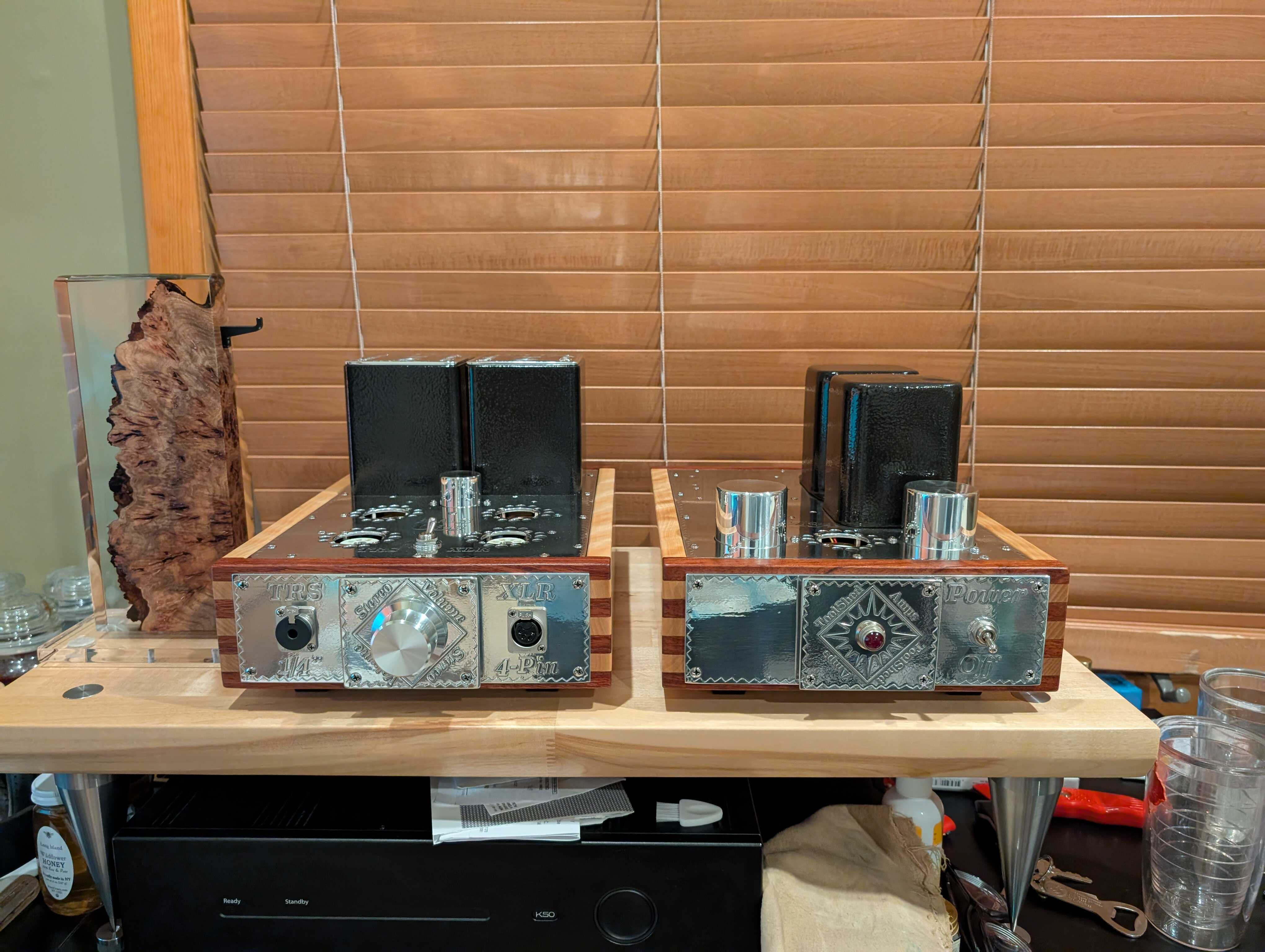
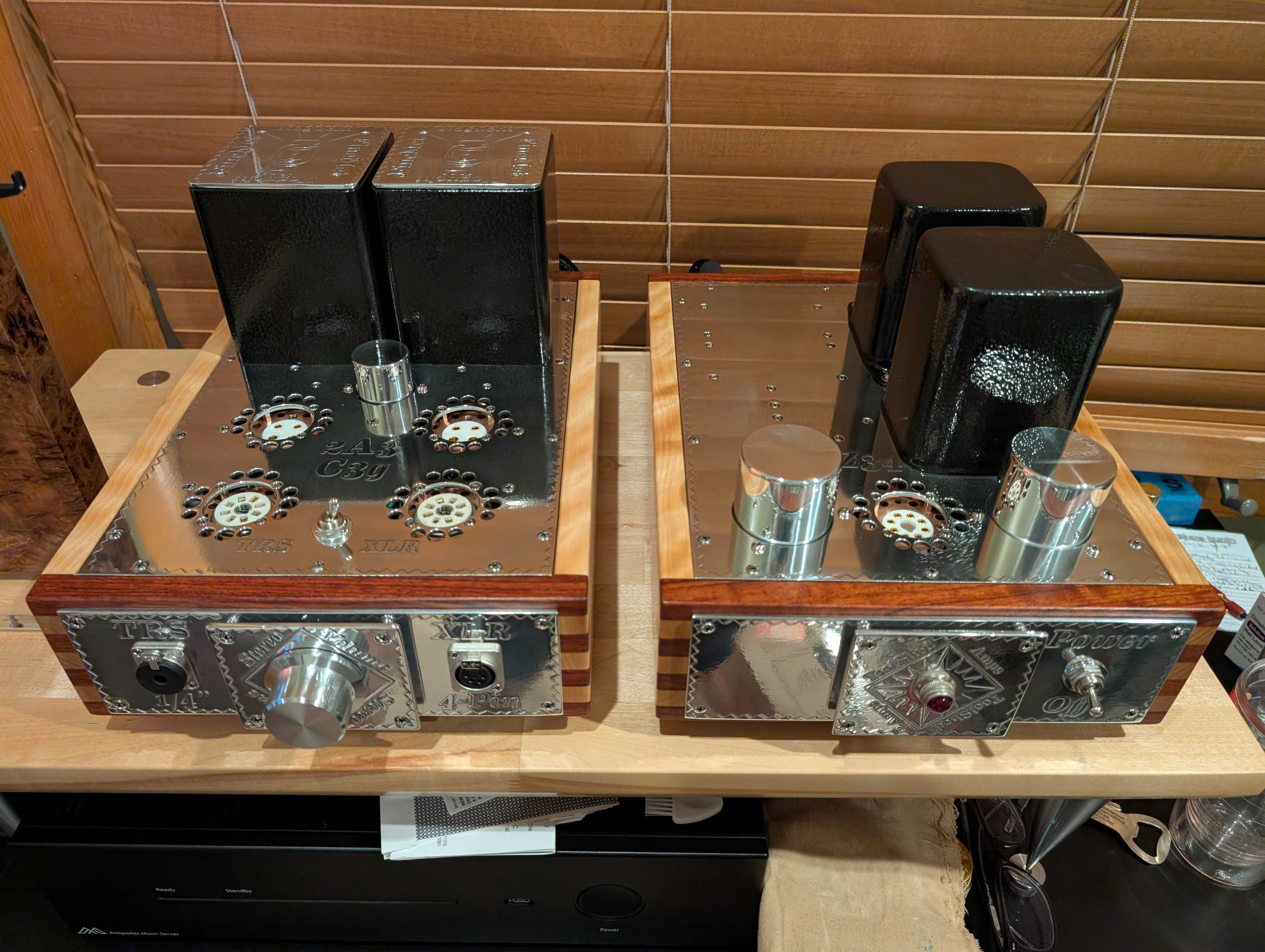
I barely got it set up. Work is pulling me a lot so maybe i get a listen this weekend
11 Likes
My wife saw me looking and said, “I hope you’re not thinking of buying that, it looks super expensive”. lol
7 Likes
You know a piece has an incredible look to it when one of our females can distinguish it from the usual sea of black and silver boxes
2 Likes
It definitely looks expensive, pretty cool steampunk vibe to it. Really nice cabinetry, finger joints look great.
If it was a motorcycle it’d be a pimped out chrome plated Harley Davidson! Definitely draws attention.
Can’t wait to see it all hooked up. 
2 Likes
Had the first session tonight. I started late and ended early. Work has been a killer with 11 meetings just today and needing the a/c to combat the heat and having that fuck with my ears too doesnt leave a lot of time for audio.
There are things that are really great, other things that im perplexed by. Mostly things that tend to get better after burning in for a while. The system has been sitting for almost 2 months so everything probably needs a bit of time.
Here are some specs:
- 1750mW (1.75 W on a bad day)
- Choke input, tube rectified, outboard, linear power supply
- 9-conductor, shielded umbilical cable
- Tokyo Ko-On-Denpa (TKD) P65CS stepped attenuator
- Jupiter Condenser Ag Silver foil “Vitamin Q” coupling capacitors
- Tantalum Non-Magnetic resistors
- Proprietary, discrete, regulated DC power supplies for the driver stage as well as output stage and pilot light.
- Heavy-metal anti-vibration/resonance-rejecting tube socket mounting plates w/Teflon sockets and Soviet Ag ceramic loktals.
- Noguchi fineMet, nanocrystalline-core output transformers.
- 79% Nickel, High-Impedance, Ono-crystal Cu Input transformers.
- Vintage (1950’s) Western Electric Solid-Core, tinned-copper, cloth jacketed signal wire
- 16ga. Silicone jacketed ground wire
- 10KV Silicone jacketed 18ga. HV wiring
- Grid-Biased, “peeled” C3g driver stage.
- Polished 3.5mm 6061 Aluminum plates set into a mirrored pair of oiled Bubinga/Flame Birch 2-Tone bases.
- Completely hand-built, engineered, in-house.
10 Likes
That picture… 
How many steps?
3 Likes
42 or 48. Its the extremely highly regarded unit from TKD that was also used in LAMM amps.
I used like the first 4 steps with the Utopia.
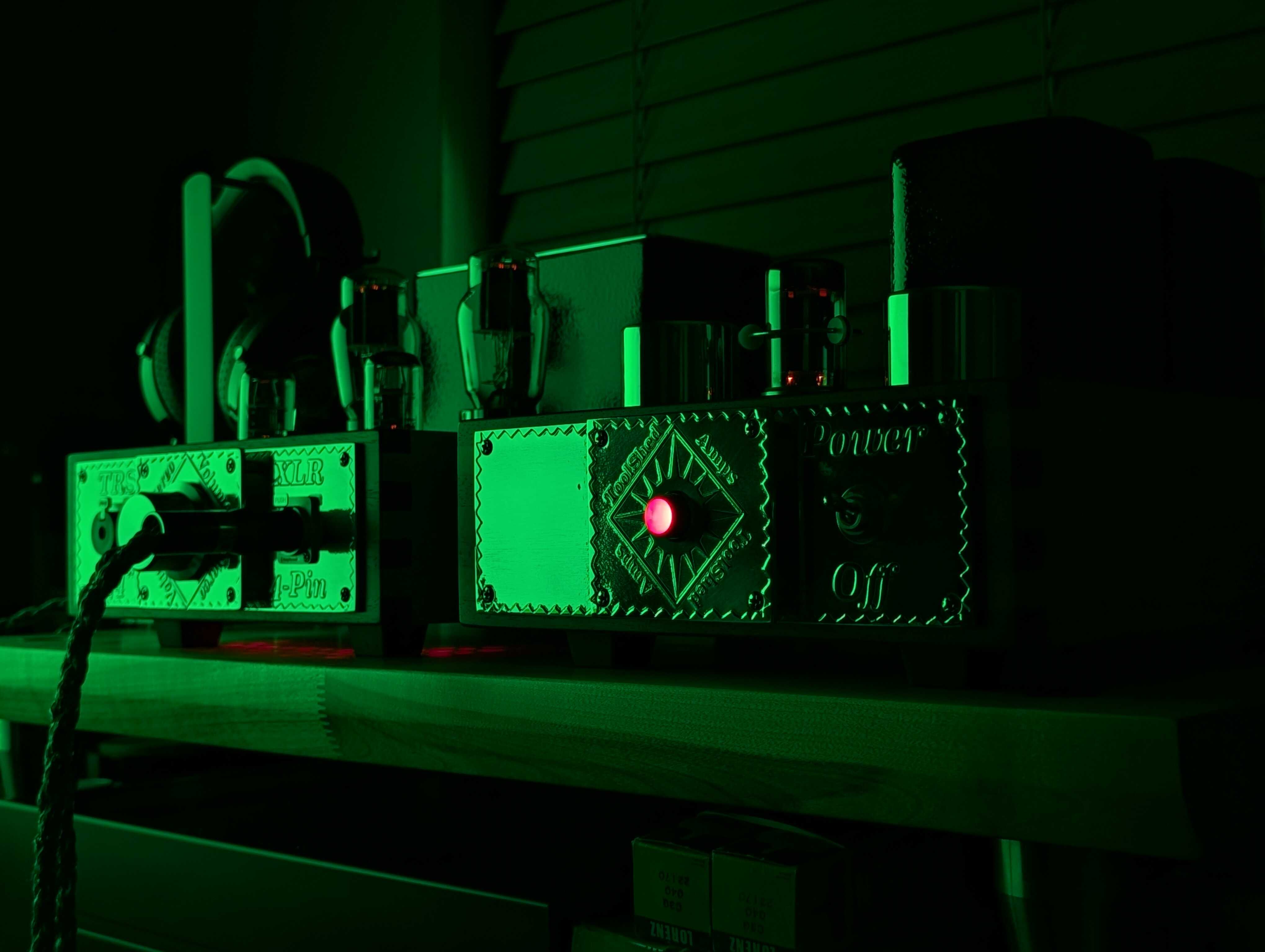
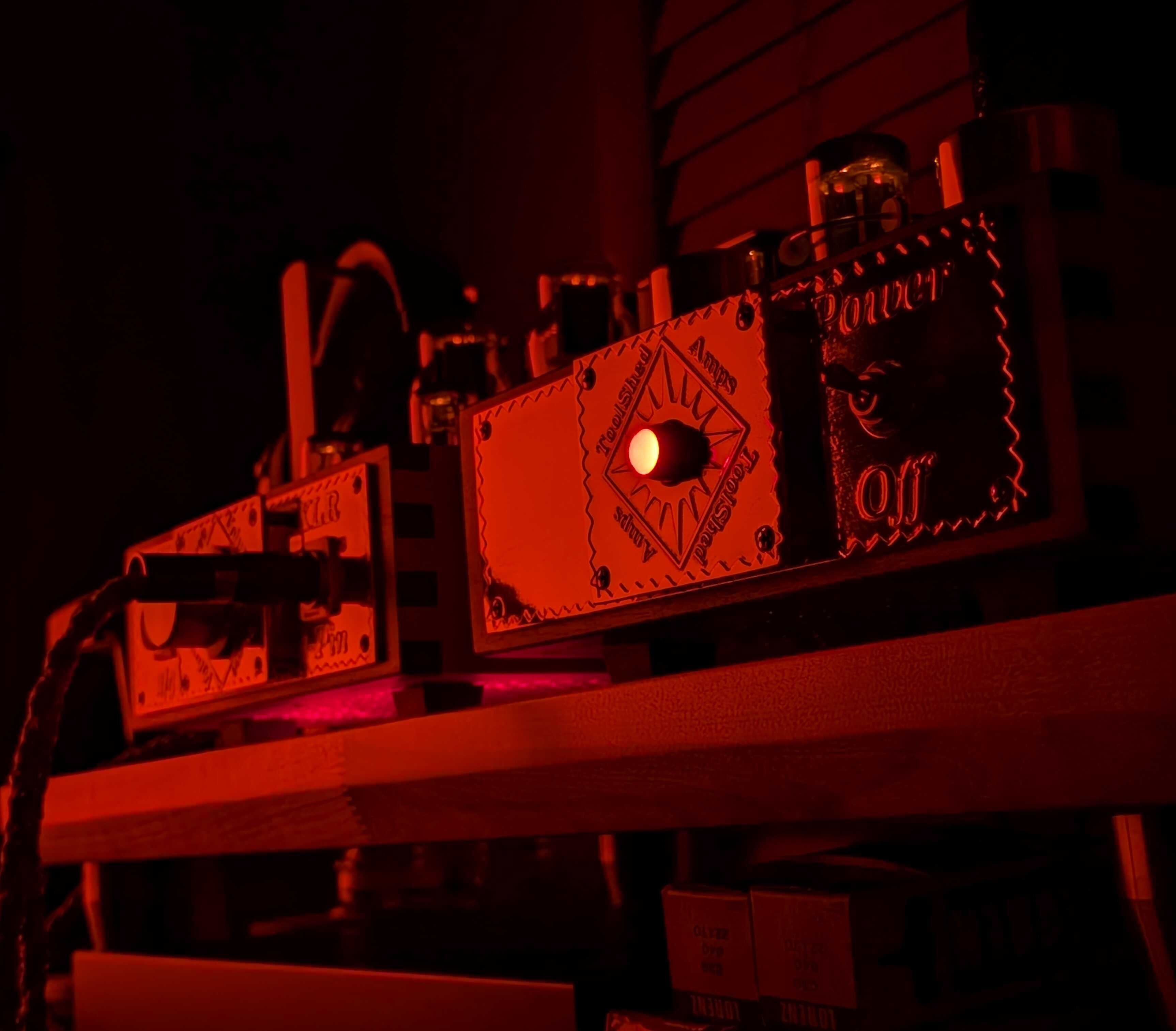
@hifiDJ what about this pic? I experimented a lot with color last night. Fun fact, the pixel cant capture purple, it just comes out as a blue. Tbh the camera kind of sucks.
6 Likes
This is why I put an output attenuation switch on my Hybrid amp.
It really is insanely sensitive and the MySphere 3.1 is worse.
3 Likes
Tbh, the steps fit well. Im sure ill have days of betweens but no complaints on volume mismatching so far.
1 Like
Good too, but maybe I dig the contrast of the green a bit better. I like the positioning of the red though, makes the amp look bigger with that angle.
Same with the yammy on the Allnic amp 
1 Like
I think the green and you’ve got this year’s Christmas card for friends and relatives.
2 Likes
i want some well lit, “normal” pictures!
1 Like
Matt, has your TS amp woken up yet? How is it sounding in your system?
1 Like
The amp arrived right when the busy season hits for work. It is something i feared and i tried to get the builder to hurry up to avoid. But too many things popped up and time is very short now.
I had a very short listen but it was very mixed. I have been trying to get 50+ hours on it again before commiting more time. Some days i dont even have time to run it in the background while working.
3 Likes
So just short of a year in of owning the amp and its been my lowest time spent listening to music. While not all due to the amp, there have been plenty of other life circumstances, a lot of it has been a dissatisfaction with the amp.
I have given it over 200 hours of burn in but each session i had to hang it up around the 30 minute mark, not even long enough for most albums. There has been a very prominent forward push in the upper vocals and the soundstage felt like you were holding a piece of paper on edge and the left and right were coming out of each side of the page.
Combined these two things really prevented me from spending time with the amp. Only being able to get a few minutes out of it felt like a waste of time and tubes, which then degraded into a “why bother” situation.
Well, i can sell the amp now that I have the Studio T, but especially in this market i doubt ill get 50% back on a brand new amp. Instead i want to make this work.
My first step is to swap out the coupling caps. Why? Because they are probably the easiest and cheapest component to change. A matter of fact when the amp was built Matt specifically out them in a spot for easy swapping. Heat up the turrets, pull out the caps, put the new ones in.
The big questions are how much will this help or change the sound, and also which caps to try. The first question we will not know until we try, the later is a little easier to figure out…
The caps in there now are Jupiter Silver Foil Vitamin Qs rated at .22uf / 600v. A pretty good thing as caps that value are usually decently priced and not too crazy sized. The silver foil caps are also usually crazy priced so selling those can fund all the others.
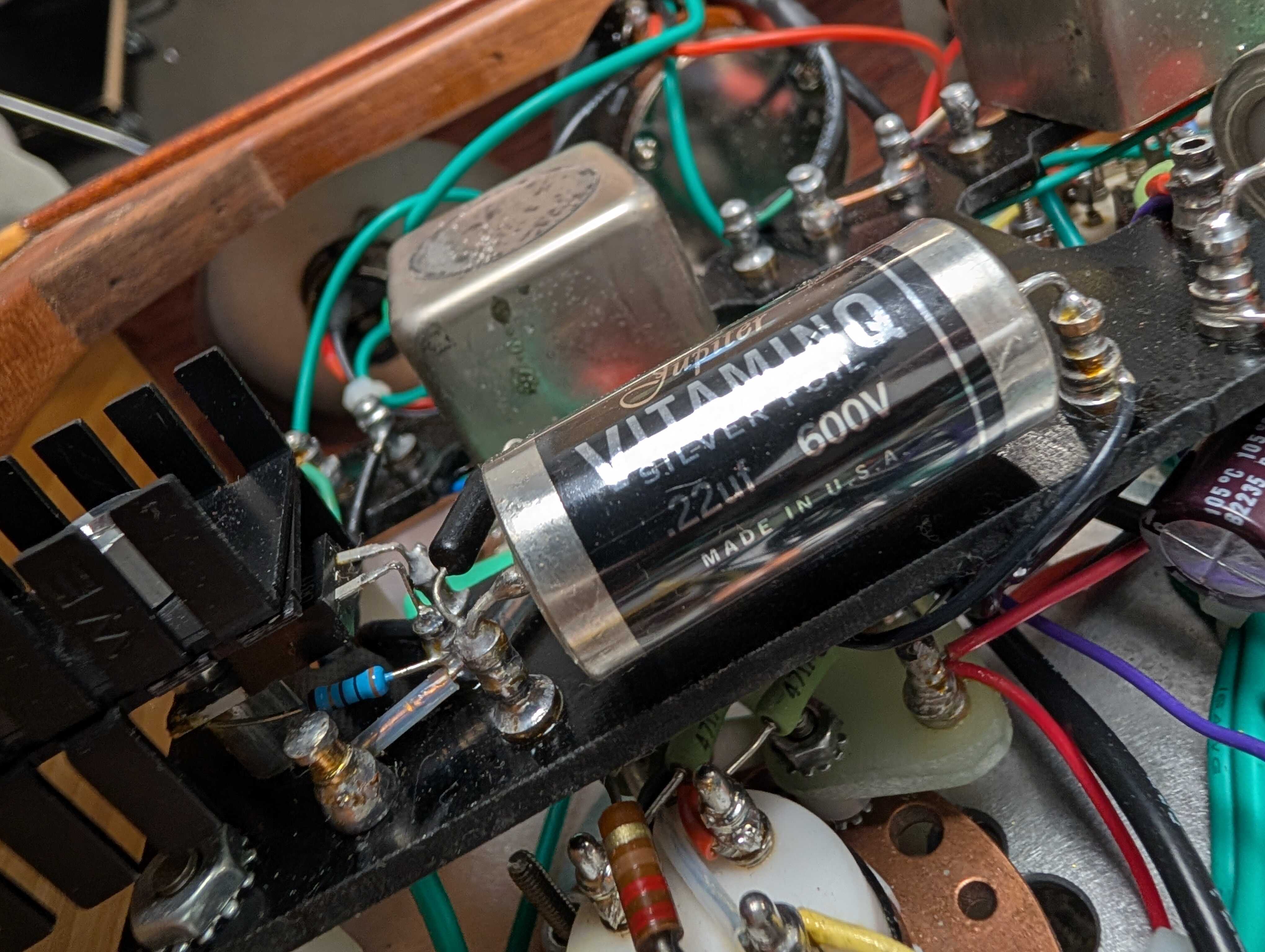
My question for the group is, anyone have any preference for caps?
On my list now are the following:
- Jupiter paper-in-oil, copper foil - seems to be liked by SBAF
- Miflex KPCU 01 - another favorite for the rich sound lovers, used in the Radu which matches this description
- Dueland Cast Tinned Copper - A big winner and well praised in a lot of the cap shootouts
The real big question is a lot of these that were rated were done via speaker crossovers, the variants built for coupling may react different due to circuit layout, use case, and/or capacitor shape and build differences. SW1X did some tests with coupling caps in their dac and they chose a very unlikely aluminum cap, so who knows the outcome.
But i am happy to listen to any advice or experience people have had and maybe we do our own cap listing.
7 Likes
Hello,
Yes, I’ve already had 2 or 3 experiences with the caps, but also with resistors.
My personal experience has shown that it’s not just the caps alone that are the sole problem or issue.
Resistors also have an influence on this.
That said, I would always add the resistor last for fine-tuning, after the cap has been added following the burn-in period, in the right place – usually beneath the tube socket to which it is connected to the circuit.
My top 3 capacitors:
Vcap CuTF: a large and wide soundstage, very detailed and rich. Very articulate with a solid bass foundation. Excellent midrange, particularly for vocals. The treble is never harsh or shrill. A good balance between warm and neutral tones, depending on the tube as well.
No. 2: Audionote Copper – actually more on the hi-fi side in terms of tuning, but it sounds very good overall: refined, spot-on, slightly more intimate in the vocal range with proper dynamics and focus in this area; I personally like it a lot.
The bass is powerful enough; overall, this cap never sounds thin.
The detail and treble range tend to be smoother – never shrill – wonderfully balanced and well-defined.
This aspect is also rendered in a refined manner.
I like this cartridge because it invites me to listen to music rather than analyse it.
One drawback is that it needs to be insulated with heat-shrink tubing before fitting.
Sonically, the tonal character leans more towards the warm side.
Top 3:
The Vcap Odam is another cap that deserves more attention; don’t underestimate it. Overall, it always sounds clean, slightly less so than the CuTF, but warmer than the TFTF.
This cap is also special in its own way because the overall sound is well-balanced, without anything sounding sharp or shrill, or anything being lacking.
The reviews are indeed genuine.
It’s a very good all-rounder of a cap; it’s well worth it and I’d choose it over the Duelund.
I’d fitted these in my Feliks Euforia back then on the output side of the tubes, and they offered a significant improvement over the standard Mundorf caps that came fitted.
Every aspect and element of the music was an upgrade.
All the 6AS7G and 6080 tubes sounded very different afterwards.
And you didn’t necessarily need to buy expensive tubes like the WE421 or 5889 – or whatever they’re called.
A standard RCA or a good 6080 sounded just right and more authentic with them.
In the end – and I only realised this later – I really should have tweaked the resistors on the Feliks Euforia before swapping it for a Zmf Verite Closed.
To return to the subject of resistors, the Audionote Tantal is a very good resistor that is well worth the investment and adds the final finishing touch.
If you’re looking for a more V-shaped response, the Transam from Japan is also a very good choice, provided it has the correct value.
In the end, it’s worth swapping out the resistors at the input or output of the tube socket – where the circuit is connected – if possible.
The secret is actually not to use too many.
Three or four may be sufficient.
The Kiwame resistor are certainly of good quality, but they have a very warm tonal character.
My personal recommendation, even for the capacitors, is to take a moment to reflect: what am I looking for? What am I missing?
What tonal direction do I want to go in – warmer or more neutral?
This helps you find the right ones rather than being disappointed afterwards.
Once the capacitors have been swapped, everything is back to square one.
5 Likes