Currently I use Qobuz through a Roon Nucleus but I also have the Qobuz app which works the same on my desktop
Quick thoughts on upgrading from the ultraRendu+FMC to the opticalRendu:
I did the swap in my system and I was ready to put on my critical listening ears to really work to hear a difference, but the difference between the two is really not subtle, the separation I’m hearing should not be this much better, I don’t know what’s going on, lol.
So yeah, I’ve been quite impressed with the opticalRendu so far, whatever it’s doing seems like it’s definitely better than just throwing an optical connection on an ultraRendu.
7 Likes
It is IMO the best in class type product for its price range. Like the Pi2AES owned that entry getting off of the PC streamer with a hat category. The opticalRendu offers that next level plateau that you’ve probably have to jump into the $10k dedicated streamer/server to appreciably improve upon.
2 Likes
… and then you add a next level power supply… and next level ddc… 
Mostly joking around, I fully agree with the assessment here. The oR is an exceptional product, glad they finally have it up for sale regularly again with the V2.
2 Likes
And then you find yourself with a K30 stack or a K50. 

I might bite on a V2 next year.
1 Like
Sorry for the stream of consciousness questions but I keep putting off asking so I just decided to send it:
A couple questions I’ve always had about these optical isolation devices (not just sonore) are
-
does the noise not effect the laser that generates the optical signal in the first place. Is the noise present in the sender not just baked in to the optical signal?
-
if you need to power the receiver with a good LPS, why not just power the sender or streamer itself with an LPS and eliminate the need for the optical isolation part.
-
Is the signal dependant on the quality of the optical/electrical conversion that must happen the in receiver
I guess I just wonder exactly what problem the optical isolation solves and if it’s a magic noise eliminator, why doesn’t this just kick the same problem down the road to the receiver device?
I guess to ask it another way, why doesn’t the optical input of every DAC always sound perfect and noise free?
If my DDC has a good optical out, is that the same thing?
I would really appreciate any guidance here. I’m trying to plan for 2024 and wondering whether to go with one of these streamers or a better DDC.
Nrom my understanding it’s not a laser just an led at least on a Toslink optical out. It may be a laser in an SFP transiever. No noise in light however the noise element is in the Ethernet portion of the connectivity, noise that can come in from upstream sources if not isolated and noise that can come from a power supply or simply ambient noise that would then affect the Ethernet signal and clocking.
I think this question is also answered by my previous answer but let me know if it doesn’t.
The signal that gets converted, transmitted and then converted back is all Ethernet and is error corrected and very robust. What we’re safeguarding against is timing errors and external noise getting in. Optical is impervious to external noise getting in, and with a better power supply, good design that included galvanic isolation on the Ethernet side and improved clocks, the benefits are more evident.
No but not because it isn’t capable of it being noise free. It’s just that it’s become a ubiquitous source, cheap and relies on cheap conversion that is usually housed in a cheap environment so you’re generating clean signal but in a cheap way. Think of it as giving a great chef, shitty ingredients and tools. They’ll be very limited in what they can give you. In other words, not their best.
No. Again the previous solution is for Ethernet conversion. Getting the signal in as clean a way transmitted from point A to point B. The optical out from your DAC is not Ethernet it’s Toslink a type of optical SPDIF.
I think the easiest way to plan is to tel us the following:
What’s your budget.
What your existing chain is and what are you trying to improve on.
and what are you physical limitations, where is point A and where is point B.
That would get us off to a good start.
3 Likes
There is Jitter introduced by the conversion from Electrical to optical and optical to Electrical, Whether that matters depends on if the device re-clocks that afterwards.
For something like optical ethernet, it’s packet based, so the receiver buffers it, and the clock isn’t used at all so the Jitter is irrelevant.
Anything after the optical cable is a source of noise, so the quality of the PSU matters, anything before it is “isolated” by the optical cable.
Simpler devices will generally produce less noise, a PC produces lots of noise, a good optical bridge ought to be much less.
Having said that it’s more complicated than that, and it depends where you believe relevant sources of noise come from.
No see first point.
However the receiver can introduce noise of it’s own.
Because unlike optical ethernet which is not clocked, SPDIF caries the audio clock, and all the jitter problems at the source and in conversion apply.
As a side note this is why TosLink cable quality matters.
3 Likes
Thank you both for the replies.
I need to read them over a few times to really try and understand.
My situation now is that I have a NUC downstairs with ROCK installed that I use as a roon server.
I use my gaming PC USB out to a Matrix Audio Xspdif 3 and then I use the SPDIF and optical out to my Yggy and TT2. I recently upgraded my RCA/Coax to BNC spdif cable to a boomslang at CAF and I have a lifatec optical toslink cable.
I went the DDC route to preserve my ability to get PC audio (gaming and videos) through my gear and still have a good source for critical listening through roon. At this point I don’t know exactly what I’m trying to improve, but mostly just wondering if trading up to something like a Mutec vs keeping the matrix for PC audio but going the streamer route for critical listening will give the most improvement.
I understand that there’s no free lunch and the recently launched new sonore got me thinking more about this route, but brought up all these old questions I had about the approach.
IMO getting off the PC for audio is the biggest win.
There are relatively cheap ways to determine if streamer is a win.
Buy a Raspberry Pi, install Ropie and use it’s USB into the Xspdif 3, it’ll give you an idea what getting off the PC will buy you. There are better solutions, but it might help you decide if the investment is worthwhile for you.
When I still ran PC audio through my primary system, I really had no regard for quality from it, in which case just run optical from the PC to the DAC, it can’t introduce electrical noise to the DAC that way. You’ll get all the Jitter as normal when playing from the PC, but depending what you use your PC to listen to it might not matter.
I actually run my PC through a separate DAC/Amp these days, and just plug in headphones when I game.
3 Likes
This is going to yield the best results but it will likely wind up being the most expensive. There are lots and lots of of good used streamers out there and then there’s even more gain by chaining a DDC between it and the DAC. But again if you’re still getting audio out from the PC I’d also second the recommendation of just getting a streamer as that will give you improvement enough and you don’t have to architect an entire optical Ethernet link for it. There are benefits but this is something that you can do in steps and if done right, you won’t waste a penny on gear as much of it can be used as part of a building block process.
You don’t have to get off the PC if you want good gaming sound and decent audio for general computing. You can do both and also get a streamer as a Roon endpoint.
4 Likes
You can possibly look into the diretta approach. There’s a lot of ways to use it and I think it can help reduce your boxes. Basically the way you would set it up would be like this:
PC → ASIO Bridge (good for windows sounds like YT/Netflix/etc) or Roon to diretta box
NUC → stream to diretta box
Diretta box (afterdark, Holo Red, rpi w/ Gentoo player, etc) → DDC → DAC
You can have two things pointing to the diretta box and that will be the thing that outputs your sound to your DDC/DAC. The way you stream can either be a direct connection from PC to that box or you can go through your network. The afterdark one that I purchased also has multiple USB outputs so you can have your TT2 and Ygg hooked up if you would like. Just an option to consider.
2 Likes
Thanks again everyone.
I decided to burn some extra cash and jump on a Sonnet Hermes that was on USAM yesterday so I can do some comparisons with the DDC from my PC.
Now I just have to keep myself from buying a Sonnet DAC to try their Ethernet I2S link!
6 Likes
There was a Pasithea listed recently the guy was practically giving away…just saying.
1 Like
Would love to see pics with the lid off when you get it. Definitely will keep an eye out for your impressions.
1 Like
Here are some pulled from doodle


4 Likes
Thanks.
Will do.
I’ve still got my eyes peeled for a used Mutec, Weiss or Berkeley DDC too
1 Like
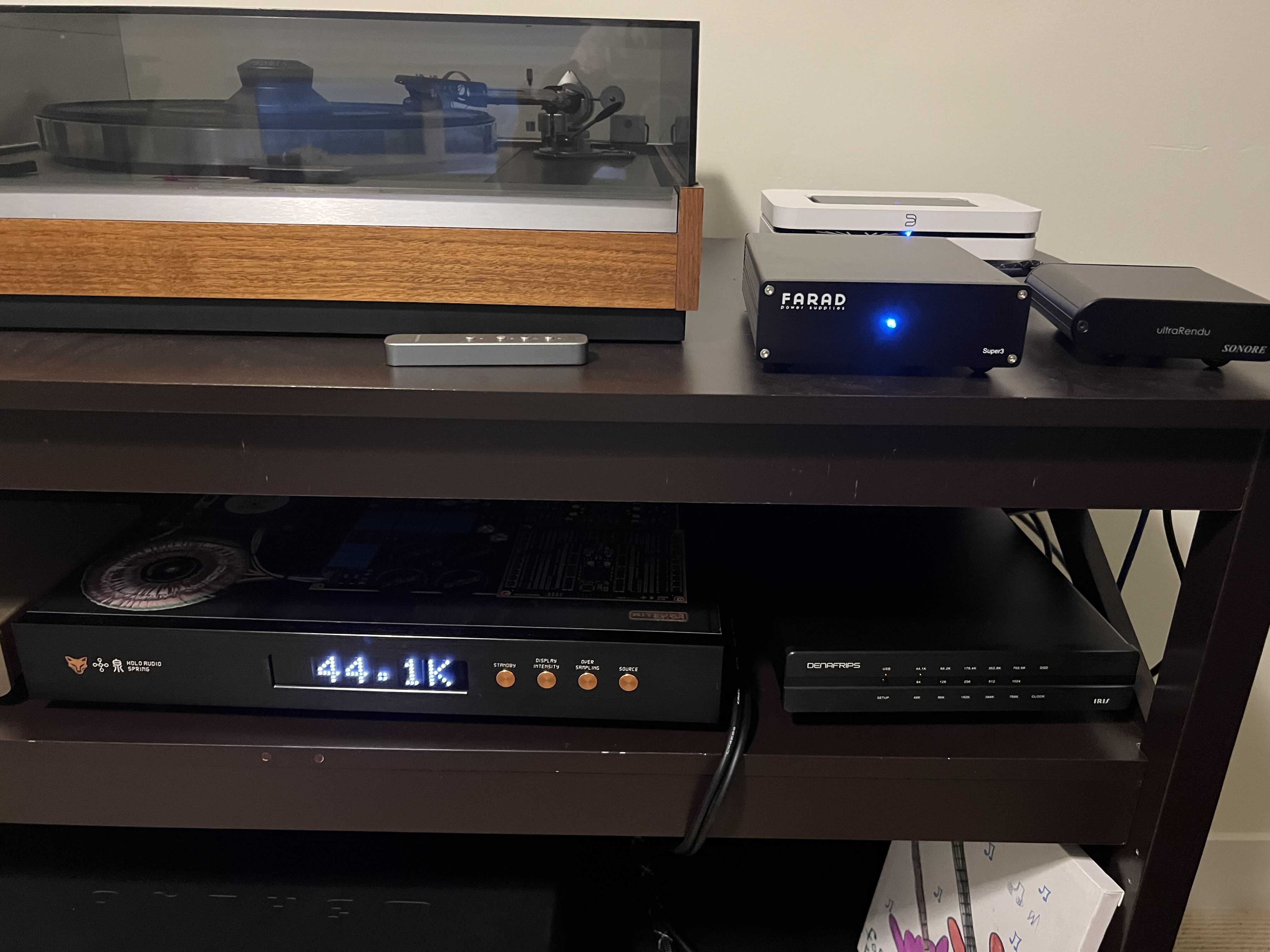
Finally got the ultra rendu -farad lps - iris setup going this morning. Seems like an immediate step up over the BlueSound.
I ended up going with Spotify premium because a free trial and seemed the easiest and easiest. Staying away from roon and the bubble stuff didn’t seem to work with iPhone/iPad.
I also am only getting 44k through this setup and nothing higher res like amazon through the node. Also having a wired connect only is frustrating so may need to find another room for it. Mixed feedback thus far
7 Likes
After about a week of listening I’m pretty thrilled with the chain and investment. So much so I’m shopping for signature rendus.
Questions on this ad;
Does this appear to be the latest version or an older rev?
Will my farad 7V lps work with this or do I need to by a different lps?
Is this priced appropriately given current market and how long posting has been up? If not what is a decent price?
Will this be a substantial improvement over the ultra rendu?
2 Likes