Winyl is really a sleeper for now simple it is lol. You can actually tune musicbee to get close to winyl, they use the same underlying playback library iirc, but it is more heavyweight and that might be one of the reasons why it doesn’t start the best.
If you can use KS output that will help, it’s sorta been the consistently best sounding windows output mode if it’s supported by your driver imo. It’s worth trying different output methods as wasapi/asio/ks/ds/mme/etc are all different, but the top 3 always ends up being KS, ASIO, and asapi exclusive to me
Any reason compelling reason why one over another? Now that I’m done tweaking around the edges, I’d like to try and use a dedicated player to compare against Roon and to primarily listen when I’m on on my PC.
Previously every comparison I’d made hadn’t netted anything meaningful vs. Roon but might as well try again.
Roon has made some pretty staggering leaps and bounds in stability useablity and just damned good user experience (finally) it’s also easy for my wife to use and I use ARC in the car exclusively and ARC right now alone for me is a compelling reason to keep it. But I’d be remised to not actually try something direct.
I just read through the JPlay Femto site and figured I’d try that first, but would be nice to hear some meaningful pros/cons.
Winyl if you like free simplicity, HQP if you like DSP hell, JRiver if you like refined balance, JPLAY is sort of a slightly different beast just because it’s all about optimizing the system itself per se, it’s been too long since I’ve used it to say how it is at the current moment, but it basically tries to optimize everything for you and that’s still valuable, it’s a shame it’s not available for Linux lol (but with how specialized the tuning is, it would be a lot of work for any different os)
There’s others I didn’t mention like audirvana or amarra luxe but I just didn’t find those as worthwhile to me personally for their cost, but may still be worth a look
As a personal note of why I like JRiver the best, aside from full memory playback, I feel like it handles internal volume really well and with built in sample over protection that really does help with lot of modern music, I’ve just found it the most consistently full, spacious, and resolving player. I do think it might slightly soften or lack edge in some cases in my setup, but overall the tradeoff is worth it compared to other players I’ve tried. This is with Linux specifically, I haven’t used jriver on windows in awhile to say how that is
UI wise it’s a bit dated in design vs more modern design language but that doesn’t bother me one bit. A ton of features that are genuinely pretty helpful, reasonably fast, and not complicated to get it to do what you want, so usability has no issues in my mind. I also think cost wise, it’s pretty fair for what you get, and also not too intrusive in licensing from both a drm and phoning home perspective as it’s mostly all on your pc (absolutely despise cloud focused apps for this where they’re constantly sending out data or pulling from cloud services, especially if they’re a subscription service)
After a bit of research, apparently Winyl uses an audio framework/engine called BASS. MusicBee does use that too, but I feel that there’s some layer or something the audio’s going through which sort of damps it down, kinda sounds like audio normalization to me (and yes, I did disable it in the settings so it’s not specifically that). With tweaking I suppose it could catch up, but I managed to find other options.
Looking for other players using BASS, I came across two others that are ongoing. Most popular is AIMP, and another lesser-known one called FoxTunes. They sound strikingly similar to Winyl, and I’d say actually improved on it. Both are a bit more cohesive, resolving and tonally denser, no doubt partially helped by how both can now load/cache files in memory (in AIMP’s case it’s up to 250 MB which is alright for my majority PCM FLAC library). Pretty happy with either, I’d actually say that FoxTunes edges out AIMP by sounding slightly more airy and resolved while AIMP is a little thicker-sounding, but its interface is a bit too simplistic and rough by comparison, while AIMP’s is pretty good.
To me it sounds a little restrained or laid-back, kind of the opposite of Foobar which is tending towards bloated and brittle.
Yeah I’d agree, it has the potential but it’s not as out of the box good
Oh awesome! I haven’t heard of those, I’ll have to give it a shot, having ram playback is a pretty big thing for me, winyl with ram sounds pretty killer lol
In my setup I wouldn’t say restrained but definitely is slightly more laid back, it works out well for some of my music and my setup I think lol. I would maybe end up with a different player if I had a really relaxed setup though, probably something more direct and energetic. Another thing I should also consider is the level of optimization I’ve done to my system already that lends itself to be very direct inherently, so that plays well with jriver to achieve balance lol (since I did balance the system sound overall specifically with the expectation of jriver being my only player)
Listening to it more, AIMP does seem to tend in that direction a bit, might work out for that circumstance.
Another quick thing worth a try is MPV just to see how it sounds. Very up-to-date video player, pretty much the best around, really, with an amazing depth of configuration that’s actually done through commands in its config file. I previously thought it sounded energetic and impactful, with a really sharp edge, and afaik it buffers a lot of video/audio by default, which can be changed from the config.
Edit: Ok lol I configured MusicBee quite a bit, including loading files into memory, and it’s caught up to the others, I think. Probably the most similar sounding to Winyl and I think the most resolution out of these BASS-engine players.
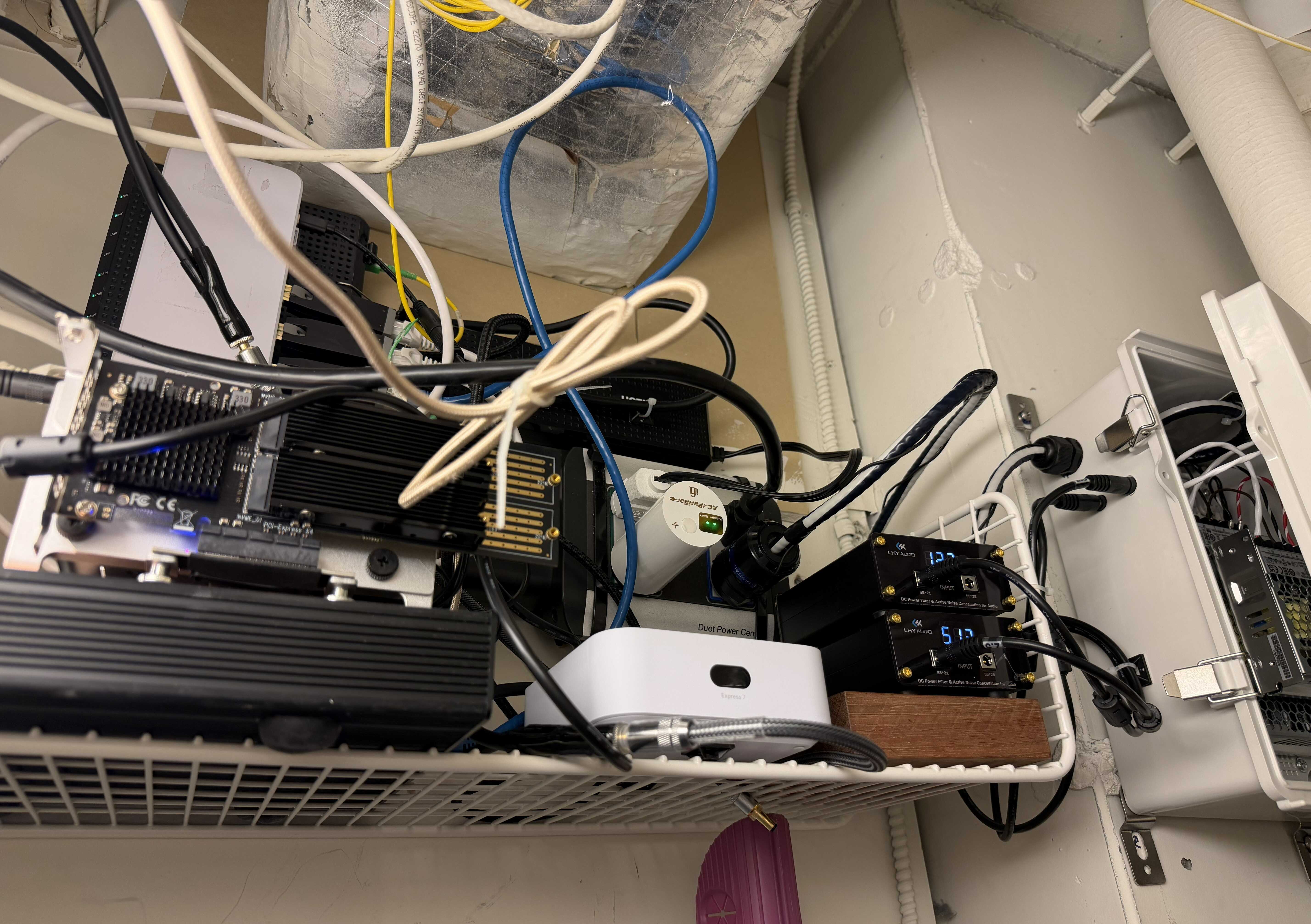
I continue to tweak around the edges, the cost is low the benefits worth the effort. Every source of noise removed helps, but this is far removed and now well isolated, and have I got the powah!
Still cleaning up LAN and DC cabling, but you get the gist of what I’ve done and where I going.
Essentially built a power box, used a old PS Audio power filter and a Shunyata Venom Digital cable as the AC and wired it to two Mean Well switching power supplies. One a 5v 10 Amp and the other a 12v 12.5 Amp, then wired the DC out into two of the LHY DC power filters I’ve been using. They’re relatively inexpensive and do a great job of cleaning up with switched power. It’s efficient compared to using LPS ad I was able to replace a ton of other power supplies.
I also used ifi Ethernet filters to isolate the Ubiquity switch from the MoCA Ethernet converters. Everything has clean power except the Verizon fiber DMARC but I threw an ifi AC filter on the AC adaptor there. I guess I can use DC power to power up but for now that’s good enough. It’s 16v or something like that it uses as back up power, but I’ve got to try and figure out if it uses that just for analog line backup power of it it will run the entire unit with the DC backup power.
The Roon NUC and the Zima NAS are also fed clean power and are using the ifi LAN filters.