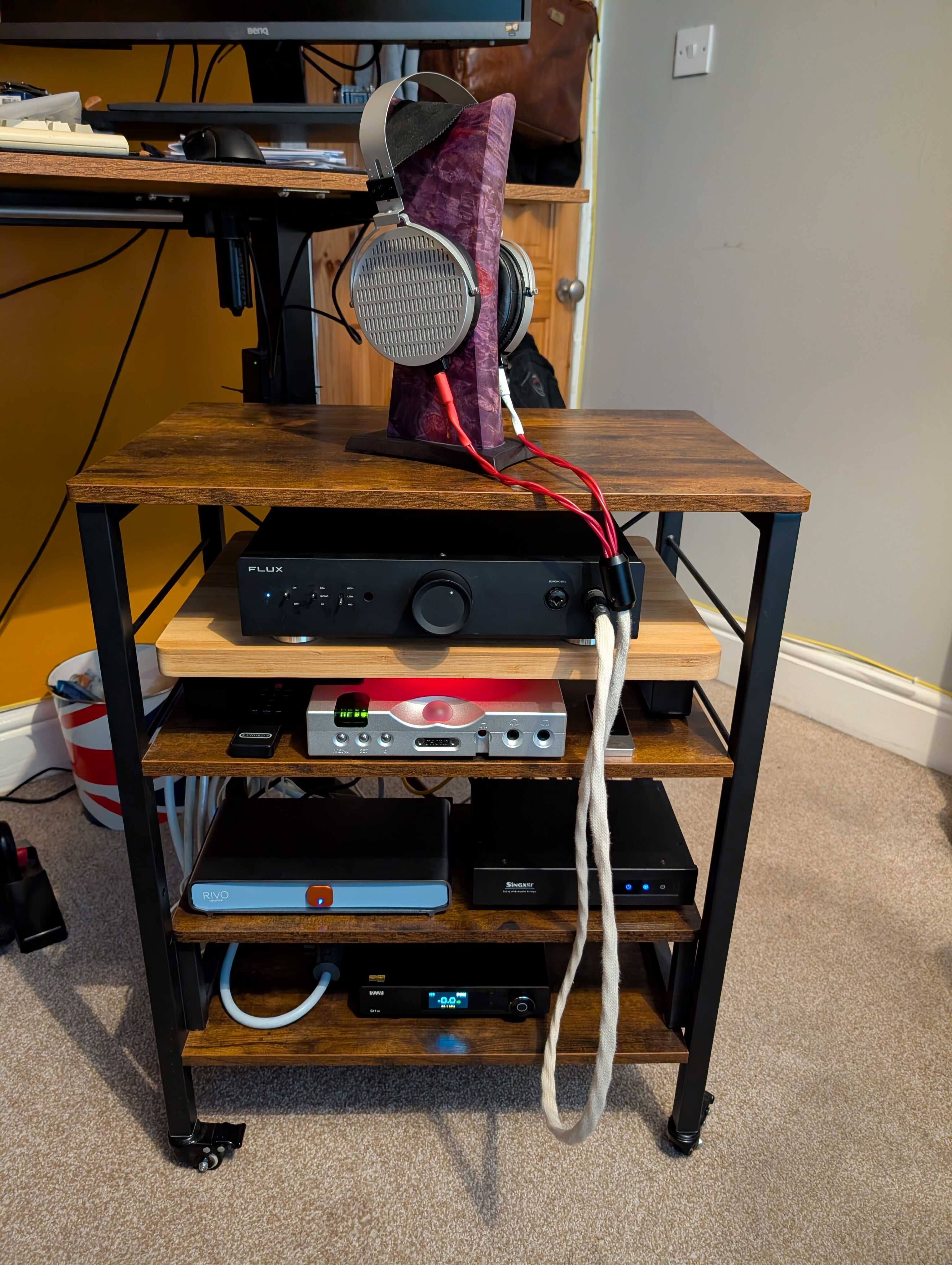
My recent DAC journey
So I’ve had some DACs in recently…
Having nailed down my chain, I just needed a DAC that aligned with my preferences and synergised with my system. “JUST!” Well that turned out harder than I anticipated. Quite a few came close but had some sort of deal breaker that had me continue the search. So, I thought it may be useful to post the list of DACs that I have had in recently and how close they got to ticking all my boxes. However, I understand that won’t mean anything unless I first attempt to describe my preferences and itemise my chain.
I like music to be presented to me, out in front, not wrapped around or inside my head. I can take an amount of staging surrounding me, provided the depth and laying is obvious/well separated, but my preference is for a speaker-like presentation …I should probably just invest in a 2 channel system! Maybe for the next house… It took me a little too long but I realise that this type of staging presentation is sometimes described as “relaxed”. Not consistently across the hobby, but at least here on SA where there is a wealth of information about many of the DACs on the hit list. As for the rest of my preferences, I favour a pretty neutral/natural tonal balance, and rarely find gear described as neutral to be lean or bass light (though I have steered clear of most of the Chinesey worst offenders). I listen to a lot of heavy rock, prog rock, but I do have a taste for most music, particularly anything well recorded or raw/natural sounding. And my primary focus when auditioning gear is how drums sound. I’m a drummer and listen to music ”backwards”; drums get most of my attention, then bass guitars, guitar, synths, etc., vocals last. The drum presentation is how I primarily judge whether I like a piece of gear or not. I wish it to sound like I’m sitting in front of the drums when I’m listening to Tool’s ‘Pneuma’, or Goldfinger’s ‘Superman’. My expectations for stage shape, width, depth, tonal balance are all driven in large part by this.
My chain:
Pixel 9 Pro Qobuz Connect > Wifi > Rivo (w/ ifi XPower) > 1.5 m AQ Carbon USB > SU-6 (w/ ifi XPower) > 1.5 m AQ Carbon 48 HDMI / 0.5 m QED Reference 40 AES / 2.0 m Chroma Coax > ?DAC? (w/ Supra LoRad) > 0.7 m Robson Acoustics Argenti Ultra XLRs > Flux Mentor (w/ Silvermann Clarity) > 1.5 m Robson Acoustics Susvara Cable > Moondrop Cosmo
Whilst it would have been really neat and tidy if I had had the exact same chain to audition all of these DACs, I did switch amps twice at the start of this DAC odyssey, but I believe I got a handle on what the amps where doing to comment on the DAC’s presentation in isolation. I upgraded my streamer and some of my cables at the start, too. However, I’d argue the same caveats and I will highlight these points when relevant.
Recent DACs and why I did/didn’t keep them around:
Questyle CMA Twelve Master
Sounded brilliant as an AIO. Neutral/natural, everything very well judged to my ear. Couldn’t push Cosmo though so I thought I’d use it as a DAC and keep the HP section just for IEMs. Unfortunately, I found the DAC section to be too lean when paired with the VMV P2 amp that I had. That amp could push Cosmo with ease but was dead neutral. This combo was punchy but was lacking the tonal balance, particularly weight in bass guitars and drums that I like. The amp was capable and I didn’t want to spend much money at the time so I kept it around and sought a weightier sounding DAC.
Denafrips Ares 12th
This pretty much nailed the weight and tonal balance for me. This had me laser focus on R2R DACs. My only critique (from what I recall) was that the imaging was hazier than I would like. It was otherwise a step in the right direction. I sold this straight away because I just wanted more of the same but better, more!
Holo Cyan 2
This one really spun me. It sounded so real. The tonal balance was perfect. It had weight but didn’t sound enhanced. It just sounded so transparent. While owning this I went through a few different streamers and briefly dabbled with Roon as I understood that this DAC punches well above it’s weight with upstream oversampling. While owning this DAC I when from using my R4, to a Sonore UltraRendu w/ Uptone PSU and then back to my R4 when I decided to sell the Cyan. I made an even riskier move just before buying the Cyan 2; I also (re)bought a Kinki THR-1 amp. I used to have one of these amps and did lots of A/B testing when I first owned it and it stuck around for a while. The Kinki is a punchy amp with a big stage. It’s more relaxed in presentation than a Cayin IHA-6, which was my reference amp until I first bought the Kinki all those years ago. At this stage, I was wrestling with my amp choice as much as the DAC. Cosmo is a tough load, 81 dB/mW @ 15 Ohms, it is insensitive and needs a lot of current. P2 was powerful enough and neutral but I feared it was too sterile/not organic enough which was forcing me to be too critical of my DAC, when it was the amp that was somewhat lacking. The Kinki THR-1 solved that problem. It sounded lush. As it happens, I somehow managed to buy my original amp back from the buyer I sold it to a few years earlier (neither of us realised until afterwards), so I knew that the amp was good and burned in and that my understanding of how it sounded still tracked. I mention all of this because I want to highlight that my impressions of Cyan 2 are relevant, even though it seems like I was jumping around all over the place (because I was). My primary criticism of Cyan 2, the only reason why I got rid of it, was that it sounded very in my face. The staging was very aggressive, up front, etc.. It sounded like I was standing on the stage, in line with the performers, so vocalists were in my head, whilst the other musicians were hard panned either side of me. This wall of sound effect was so extreme to my ears that I couldn’t perceive stage depth at all. If you have read my preferences stated above, you should be able to understand that, it doesn’t matter how perfect this DAC otherwise sounded, this was a serious red flag for me. The Kinki amp was spacious and more relaxed than many of the amps that I owned and so I made my peace that it was the Cyan 2 that needed changing and decided to move the best DAC I had heard to date on.
Laiv uDAC
I heard this was basically a more relaxed, slightly cheaper Cyan 2 but with internal oversampling. It was not. It was more relaxed but it didn’t sound a patch on the Cyan 2 to my ear. The images sounded smaller and less 3D. The stage had some depth, similar to Ares 12th, but without the weight or scale. I didn’t find this DAC to be engaging. Maybe be poor synergy. Sold it.
Metrum Pavane L3
I was real excited about this one. It was a frustrating eBay experience where I purchase a Sonnet Morpheus off a seller twice for a very good price that really shifted my thought process. It, unfortunately, made me comfortable with spending way more than what I originally set out to spend. Through reading around, I understood the Pavane L3 to be at or near the pinnacle of this particular engineer’s capability. However, my unit had a weird, intermittent distortion and so I had to send it back to the seller. I had it for a week and at least got to hear what it could do. Mon’s Morpheus description of the staging is exactly what I heard. There is a density to the presentation. All of the sonic images are 3D and separated but they’re all squashed together and kind of bleed into one another; like everything is part of this ball of sound in front of you. When you listen carefully, you can hear the distinct sonic images, however, because I had to focus hard to pick images apart, I decided that this type of presentation wasn’t for me. It hindered my perception of width and depth. It was quite distracting to the point where I couldn’t discern the other aspects of the DAC. It was at this point a Flux Mentor popped up for sale. I saw this as a sidegrade to the Kinki as they are similarly well designed and, from reading reviews of both, had a similar sound signature. Both super powerful, super transparent. The reason why I wanted the Mentor, even though I was really happy with the THR-1, was that the Mentor has switchable gain. The Kinki was all power, all the time; you can’t dial it down for IEMs. Plus it had a high output impedance; as I understood it, this was not ideal for the Cosmo being 15 Ohm, as well as my various IEMs. In between all of these DACs I was feeding my amps the line out from my Hiby R4. When the Mentor arrived, this is how I discerned the difference between it and the THR-1. Although both amps were similar on paper, the Flux sits you a few rows further back from the stage. It sounded more neutral and less coloured (less rich/saturated) than the Kinki. Part of me thought that maybe getting a Cyan 2 back to see whether the Mentor helped my staging gripes, but I had already committed to going higher end, so I proceeded with my new amp …and also upgraded my streamer to a Rivo.
Rockna Wavelight
This grew on me as I owned it for a few months. Excellent, impactful, textured, weighty bass. A bit too in my face in terms of staging, but that complaint lessened over time. A little too warm for me. I find warmth can fill the stage and reduce coherence, and sometimes even collapse my perception of depth. As many of you helpfully informed me, this aspect can be tuned out with cabling. One thing that I couldn’t get past was the treble. It wasn’t immediately obvious, but over time, I found the treble to be artificial, and metallic. Once I heard this, I couldn’t unhear it. So although I could’ve tuned it to be less warm with cables and the staging quirks bothered me less than they first did, the treble remained a concern. Ultimately, me spending a lot more money than I first decided to had made me way more critical of gear. If it ain’t exactly what I want, it is going out the door as quickly as it arrive. It was at this point that I bought my AQ Carbon digital cables and XPower PSUs to “polish” my chain.
VMV D1se2
Once I’d decided to sell the Wavelight, I bought this on a whim. I like the original D1se and just bought the D1se2 on Amazon, until I found my next high end endgame DAC. As I have written on SA recently, I love this DAC and it ranks near the top of this list for me. The D1se2 stages just how I want it to - out in front, images are discrete, depth and layering is so easily perceived. This was lacking the weight of the Wavelight but it did not lean or bass light to my ear. This DAC stuck around through the next few much high end DAC auditions. I got rid of it and then bought it back a few months after when one popped up on eBay for pennies. This DAC, the D1se2, ticks so many of my boxes that, if I were a sensible man, I would just stop here. I didn’t but I should’ve/could’ve.
Gustard X30
It was because of the cleanliness and focussed sonic images of the D1se2 that I thought to myself that maybe I preferred the more “etched” approach to imaging that DS DACs often feature. This had me buy an X30. The X30 grabbed me immediately to the point where I actually claimed that I had reached endgame within an hour of listening to it for the first time. Images were large, as was the scale of the stage. The tonal balance was excellent. Everything sounded good. However, though not to the degree of the Cyan 2, the X30 was still very much “in my face”. There was an intensity to it’s presentation that I found fatiguing quite quickly. Cosmo is a spacious sounding HP. The Mentor sits you a few rows back. X30 wasn’t in my head but it sounded right in front of me and so there’s only so much the rest of my downstream chain could do to balance it’s presentation out. I sold it within a week.
Denafrips Pontus 15th
I still had the Wavelight and D1se2 when the Pontus 15th arrived. The Pontus 15th came so close to perfection that I couldn’t actually find fault with it for the first few weeks of owning it. And even then, I’m not sure I’d claim to have found a fault. The way the Pontus 15th separates images and places them in the stage, the layering, etc., it is all so natural. Bass guitars have a brilliant, natural sounding density and weight to them. Snare drums snap, kick drums thump and toms thunder. The stage spreads out in front of you with obvious depth. Images don’t just have size, position and volume, they have shape to them! Example, I can’t recall which track, but cymbals and toms sound exactly how they are shaped in real life. It was listening to and being satisfied with this that saw me get rid of the D1se2. However, I had told myself that, even if I thought I’d found “the one”, unless that one was particularly hard to find, or I’d gotten it for a bargain, that I’d continue on on my journey and likely circle back round to it and just buy another. Though, I must admit, I very nearly settled on Pontus 15th. The reason why I made my peace parting with it was because I got a VMV D2 for a good price. When that arrived and I was A/B’n the two, it showed me that the Denafrips sounded slow in comparison. Transients were immediate on the D2, once you’ve heard a DAC’s “weakness”, it is hard to unhear it. So I parted with the Pontus 15th half thinking that I would buy another.
VMV D2
Uncommon DAC. Not as good as D1se2. Although it was very much the technical evolution of the D1se, it sounded quite similar to the D1se, to my memory (it has been a while). However, having only just gotten rid of the D1se2, the latter’s performance was keen in my memory and comfortably outdid the D2. The D2 didn’t stay long or get much of a listen. Not a bad DAC but the D1se2 was superior to my ear.
Holo Spring 3 KTE
I don’t know whether I was more excited about this or the Wavelight. This certainly disappointed me more. Because of how much I love the Cyan 2, I expected to love the Spring 3 KTE. However, to my ear, the ear gain region was quite forward. I don’t know whether it was poor synergy or not but guitars sounded really aggressive, but then drums, bass guitars, synths, etc., sounded pushed back. It’s presentation was so distracting and hard to listen to that it got the least amount of listening time of all of these DACs. Twice through my 2 hour test track playlist I think, then gone.
Aqua La Voce S3
Once I had fully committed to finding a relaxed DAC, this seemed like a very obvious choice. Particularly with how favourably it is discussed here on SA. I liked it. I figured out that my Rivo had oversampling functionality too which I believe the S3 is supposed to benefit from. However, I found it’s dynamics to be too subdued. Snare drums wouldn’t pop. In addition, I found it to be too rolled off and so bass guitars didn’t have the weight they did on Pontus 15th, nor did the shimmer sound on most of these other DACs. I liked the staging, out in front, great depth, but I thought it sounded like many of the sonic images were on or part of a canvas, with a few positioned in front - unique at least. I liked the La Voce, but for my chain/preferences/ears, it was too polite. Fortunately I bought this one from a store and was able to return it.
Chord TT2
And now we come to the TT2. I have had this DAC in my crosshairs for years. I steered away from it because of the way some describe Chord’s house sound being artificial, and thus “Marmite”, e.g., how Chord do transients, etc.. The description of neutral bright scared me off, too. Particularly because my Mentor has also been described as such. As Cosmo is my reference, the anchor which my chain is built around, I shouldn’t have necessarily been scared off TT2. Cosmo has plenty of late treble energy, but the ear gain and early treble has been carefully, expertly I would argue, trimmed. Additional treble from an amp or DAC may help Cosmo sound even more natural. And I shouldn’t have necessarily thought neutral bright = too bright, or peaky. When I first listened TT2, it sounded so meaty, balanced, spacious, detailed and natural. My perception from that first listen hasn’t changed. What I have noticed since is that, because it sounds exactly as my ears/preferences expect, I am noticing more detail in the music. I would say that this is purely because I’m less distracted from what I perceive as sonic flaws, rather than the TT2 being more detailed than other DACs above. It could be the latter but I see it more of an indication that I have found what I’ have been looking for. It has everything I want and nothing that I don’t. I still feel like I need to continue to be critical of it before I can settle but it appears that the TT2 meets my stated preferences and delivers them in this chain. I even love using it’s HP amp with IEMs. Timeless through a TT2 is fantastic. I have had a number of Chord DACs and the TT1 was my primary DAC for a while when I first got into headphones. My chain was something like: PC > TT1 > Kinki THR-1 > HE-500. It may be that what I considered to be “correct” sounding was coloured from my earliest experiences of this hobby. I’m not necessarily done as I still have some kind of Lampziator on my list, but I’m gonna sit and enjoy this TT2 for the foreseeable - it sounds bloody brilliant.
I hope someone finds this useful on their journey to cut down the search time!